
demo-attachment-654-Cloud2

For Salaried Employees, Pensioners & Multiple Employer Filers

Income Tax For Salaried in India

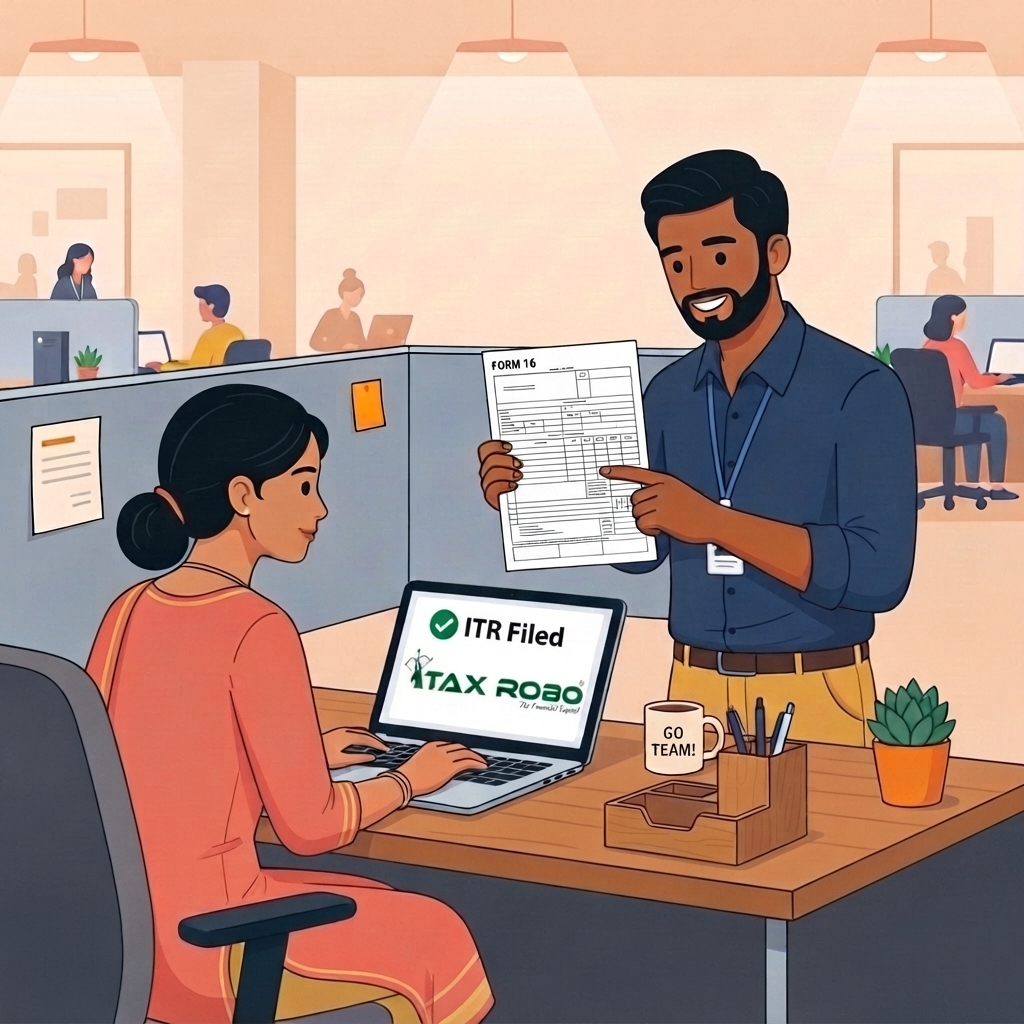
Income tax for salaried employees in India must be filed every year before 31 July using Form 16 issued by your employer. Whether you are a single-employer salaried individual, a pensioner, or someone with multiple Form 16s, Tax Robo’s expert CA team handles your complete income tax for salaried filing — ITR preparation, HRA calculation, deduction optimisation, and CA-assisted submission. 100% online. Starting at ₹749.

demo-attachment-654-Cloud2
0
+ HappyClients
0
+ Service Areas
0
% Online
0
+ Years ofExperience
demo-attachment-523-Flower
demo-attachment-586-Leaf
demo-attachment-1982-Cloud-4
demo-attachment-2538-Chart
demo-attachment-2540-Flowr-Pot

Service Overview

What Is a Income Tax for Salaried Filing?

Income tax for salaried employees is filed annually using ITR-1 (Sahaj) for simple income cases or ITR-2 for those with capital gains, multiple properties, or foreign income. Your employer deducts TDS monthly and issues Form 16 by 15 June — this is the primary document used to file your return on the income tax portal before 31 July.

  • Standard deduction ₹75,000 under new regime — ₹50,000 under old regime (Section 16ia)
  • Zero tax up to ₹12.75 lakh for salaried employees under the new tax regime
  • HRA exemption available only under old tax regime — not allowed under new regime
  • File ITR-1 for income up to ₹50 lakh — ITR-2 for capital gains or multiple properties

Key Benefits

Why choose a Income Tax for Salaried filing service?

demo-attachment-216-Cloud-1
company registration in India

New vs old regime — right choice

Choosing between the new and old tax regime depends on your deductions. Our CA compares both regimes for every client and picks the one that saves maximum tax legally.

HRA and all deductions claimed

Many salaried employees miss HRA, 80C, 80D, and home loan deductions. Our CA reviews your full income profile and ensures every eligible deduction is claimed before filing.

CA-certified filing before 31 July

Salaried ITR must be filed by 31 July. Our CA prepares your return using Form 16 and files before the deadline every year — avoiding late fees and interest.

How It Works

Simple Process —Income Tax for Salaried filing

demo-attachment-216-Cloud-1

Get your income tax for salaried filed correctly in 3 easy steps

Share your Form 16 & documents

Step 1

Send us your Form 16, bank statements, investment proofs, and other income details via WhatsApp or email. We collect everything needed.

CA computes tax & prepares ITR

Step 2

Our CA compares new and old tax regimes, claims all eligible deductions, and prepares your ITR-1 or ITR-2 for your review and approval before filing.

ITR filed & acknowledgement shared

Step 3

After your approval, we file on the income tax portal before 31 July and share your ITR-V acknowledgement immediately. Your annual compliance is complete.

* Note: Typical filing time 3–5 working days after receiving complete documents.

Pricing Plans

Simple & Transparent Pricing

Income tax for salaried filing from ₹749. All plans include CA-assisted ITR preparation, Form 16 verification, and new vs old regime comparison. One fixed fee — no surprise charges.

*Note: All prices exclude GST. No hidden charges. Government tax payment is the client’s responsibility.

demo-attachment-586-Leaf
demo-attachment-1282-Cloud-2
demo-attachment-654-Cloud2

Documents Checklist

Documents Required for Filing

NOTE :

These Documents Must Be Submitted Before Filing. Tax Robo Verifies All Documents Before Submission.

demo-attachment-688-Rock-2
demo-attachment-1277-Cloud
demo-attachment-586-Leaf
demo-attachment-523-Flower

Salary & Employer Details

✓ Form 16 Part A and Part B from employer
✓ Salary slips for April to March
✓ Form 16 from all employers (if job changed)
✓ Pension certificate (if retired)

Tax & Income Details

✓ PAN card and Aadhaar card
✓ Form 26AS and Annual Information Statement (AIS)
✓ Bank statements for all accounts
✓ Interest income from FDs and savings accounts

Investment & Deduction Proofs

✓ Section 80C proofs — PPF, LIC, ELSS, EPF
✓ Section 80D — health insurance premium receipts
✓ Home loan interest certificate (if applicable)
✓ Rent receipts and landlord PAN (for HRA claim)

Other Income & Details

✓ Rental income details (if any property given on rent)
✓ Capital gains statements (mutual funds / shares)
✓ Donation receipts for Section 80G claims
✓ Any income tax notices received (if any)

demo-attachment-5681-Leaves

Common Questions

Frequently Asked Questions — income tax for salaried filing

Got questions? Find answers to the most common questions about income tax for salaried employees in India below.

demo-attachment-1458-Cloud-3

Every salaried employee whose gross total income exceeds the basic exemption limit must file an income tax return in India. Under the new tax regime (default from FY 2025-26), the basic exemption limit is ₹4 lakh. However, effective zero tax applies up to ₹12.75 lakh for salaried employees — due to the Section 87A rebate of ₹60,000 on income up to ₹12 lakh and the standard deduction of ₹75,000. Filing an ITR is also mandatory even below the exemption limit if you have foreign assets, have deposited above ₹1 crore in bank accounts, or are claiming a TDS refund. Even if your employer has deducted the full tax as TDS, filing an ITR is necessary to claim refunds, carry forward losses, and maintain financial records.

The due date for income tax filing for salaried employees is 31 July of the assessment year — for FY 2025-26, the due date is 31 July 2026. Unlike business taxpayers who get until 31 August, salaried employees must file by 31 July. If you miss the deadline, you can file a belated return up to 31 December 2026 with a late fee under Section 234F — ₹5,000 for income above ₹5 lakh and ₹1,000 for income below ₹5 lakh. Interest at 1% per month under Section 234A is also charged on any unpaid tax from the due date. Missing the deadline also means you cannot carry forward capital losses from the current year.

ITR-1 filing for salaried employees (also called Sahaj) is the simplest option — for individuals with total income up to ₹50 lakh from salary, one house property, interest income, and long-term capital gains up to ₹1.25 lakh under Section 112A. ITR-2 must be filed if income exceeds ₹50 lakh, if there are capital gains from shares or mutual funds above ₹1.25 lakh, if there are two or more house properties, if there is foreign income or foreign assets, or if the taxpayer is a director in a company. Using the wrong ITR form results in a defective return notice under Section 139(9). Tax Robo selects the correct ITR form based on your complete income profile before filing.

HRA exemption for salaried employees is available only under the old tax regime — it is not allowed if you choose the new tax regime. Under the old regime, the exempt HRA is the lowest of three amounts — actual HRA received from employer, 50% of basic salary if you live in a metro city (Delhi, Mumbai, Chennai, Kolkata, Bengaluru, Pune, Hyderabad, or Ahmedabad) or 40% for non-metro cities, and actual rent paid minus 10% of basic salary. If you pay rent above ₹1 lakh per year, you must provide your landlord’s PAN to claim HRA exemption. If your landlord does not have a PAN, they must provide a declaration. Tax Robo calculates the exact HRA exemption for every salaried client before filing to ensure the maximum benefit is claimed.

Form 16 income tax return filing is the process of using the TDS certificate issued by your employer to file your ITR. Form 16 has two parts — Part A contains the TDS deposited by your employer with the government on a quarterly basis, and Part B contains the detailed breakup of your salary, exemptions claimed (like HRA and LTA), and deductions reported by you to the employer. Your employer must issue Form 16 for FY 2025-26 by 15 June 2026. The income and TDS details in Form 16 must be cross-checked with Form 26AS and the Annual Information Statement (AIS) before filing — any mismatch can trigger a notice from the income tax department. Tax Robo verifies all three documents before preparing your ITR.

New vs old tax regime for salaried employees is the most important decision before filing ITR. The new tax regime (default from FY 2025-26) offers zero tax up to ₹12 lakh (₹12.75 lakh for salaried with standard deduction of ₹75,000) but does not allow HRA, home loan interest, LTA, Section 80C (PPF, ELSS, LIC), or Section 80D (health insurance) deductions. The old tax regime has a higher basic exemption only for senior citizens but allows all these deductions with a ₹50,000 standard deduction. The new regime is better if your total eligible deductions are less than ₹4–5 lakh. The old regime is better if you have significant HRA, home loan interest, and Section 80C investments. Tax Robo compares both regimes for every client and files under the most beneficial option.

Yes, salaried employees can switch between the new and old tax regime every year at the time of filing their ITR. Unlike business owners who face restrictions after opting out of certain schemes, salaried individuals have complete flexibility — you can choose the old regime one year and switch back to the new regime the next year based on whichever is more beneficial. However, if you have business income in addition to salary, you lose this flexibility and can switch only once. To opt for the old tax regime for FY 2025-26, you must file Form 10-IEA on the income tax portal before the ITR due date of 31 July 2026. Tax Robo compares both regimes every year and advises each client on the optimal choice before filing.

Salaried employees commonly receive income tax notices for mismatches between Form 16, Form 26AS, and the filed ITR. The most frequent notice is Section 143(1) intimation — automatically generated after ITR processing, showing a refund, tax demand, or no change. A Section 139(9) notice is sent if the ITR is defective — typically due to wrong ITR form, mismatch in income, or missing schedules. A Section 148 notice is sent for reassessment if the tax department believes income has escaped assessment. All notices must be responded to through the income tax e-filing portal within the specified time. Ignoring any notice leads to ex-parte assessment, penalty, and tax demand with interest. Tax Robo’s CA team handles income tax notice replies for salaried employees — contact us immediately at wa.me/919150461117 after receiving any notice.

Still have questions? Our experts are here to help you choose the right service for your business.

demo-attachment-654-Cloud2

Ready to complete your Income Tax for Salaried filing ?

Talk to one of our CAs today — free consultation, no obligations. We will handle your Income Tax for Salaried filing quickly, accurately, and 100% online.

demo-attachment-688-Rock-2
demo-attachment-1322-Flower-1
demo-attachment-216-Cloud-1